
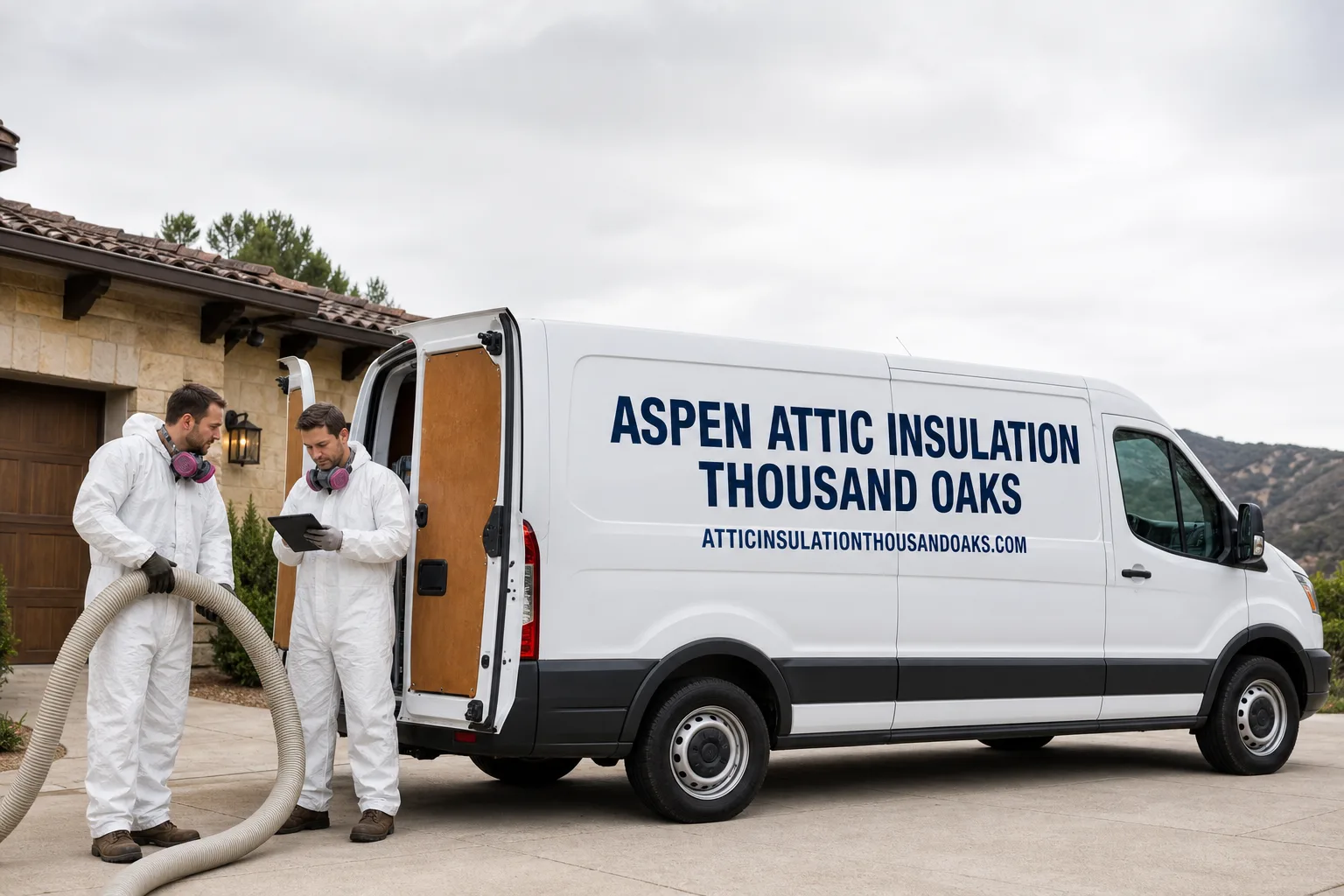
Fast, Reliable Spray Foam Insulation Across Simi Valley
Spray foam insulation in Simi Valley runs $2,100 – $6,400 for a typical attic, with open-cell on the lower end and closed-cell on the higher. Most jobs take one to two days and start with a written price before any work begins. If your Simi Valley home was built between the 1960s and 1990s, there’s a good chance your attic is doing very little to stop summer heat or wildfire smoke from moving through the house. Call (805) 309-1610 and we’ll send a technician whose name and photo you’ll have before he knocks.
Why Aspen Attic Insulation Thousand Oaks Is Simi Valley’s Preferred Spray Foam Insulation Company
Simi Valley homeowners deal with a specific problem: older tract homes, hot attics, and smoke season. We work those houses every week, from the Texas Tract up toward the foothills. Our crews know what a 1960s ranch with original batts looks like once we open the attic, and we know what it takes to make those attics actually hold temperature instead of bleeding into the living space.
Every technician who steps onto a Simi Valley property is background-checked, identity-verified, and arrives in a marked uniform with a photo ID badge. Before the visit, you get his name and photo. If someone else shows up, the visit is free. That’s the Threshold Standard, and it’s how every job runs.
We put the price in writing before any work starts. No post-job surprises, no vague verbal numbers that change once the crew is in your attic. The price you see is the price the job costs. That also applies to our Spray Foam Insulation work across every Simi Valley neighborhood. And every job carries the 365-Day Done Right Promise: if the work isn’t right, we come back and make it right, in writing, covering labor and materials for a full year.
When you call, a live person answers. That’s true at 2 p.m. and 2 a.m. No voicemail loops, no call-back windows.
Spray Foam Insulation Contractors in Simi Valley
Spray Foam Insulation Contractors in Simi Valley do more than spray foam. They assess how your specific house reacts to Simi Valley heat, where the air leaks are, and whether the existing insulation is helping or hurting. In a city where summer attics regularly push past 140°F, the contractor’s first job is to find every gap at the top plates, every unsealed can light, and every place outside air moves in.
A full attic job in Simi Valley typically runs $2,100 – $6,400 depending on square footage, existing insulation condition, and whether you need open-cell or closed-cell foam. Homes near the foothills often need closed-cell for its added structural rigidity, while tract homes in the flatlands may do fine with a flash-and-batt hybrid that keeps costs down.
When Retrofitting Makes Sense
If your attic still has the original blown-in fiberglass from when the house was built, that material has likely settled to half its labeled R-value, especially at the eaves. Spray foam applied to the attic floor seals those edges and stops the thermal bypass that makes upstairs rooms unusable in August. This is a retrofit, not a patch job, and it’s the most common project we do in Simi Valley’s older tracts.
When Full Removal Is the Better Call
Old fiberglass that’s been compressed, water-stained, or packed with rodent droppings should come out before any new insulation goes in. Closed-cell foam sprayed over degraded batts traps moisture against the drywall. In Simi Valley’s winter condensation conditions, especially in homes near the foothills, that moisture can lead to sagging ceilings. We’ll tell you straight if removal is needed or if we can work over what’s already there.
Spray Foam Attic Insulation in Simi Valley
Spray Foam Attic Insulation in Simi Valley is the fastest way to change how a house feels in July. The attic is the main heat exchange point in most Simi Valley homes, and sealing it properly does two things at once: it blocks the superheated attic air from pushing into the living space, and it stops conditioned air from leaking out through the ceiling. In a city where Title 24 energy code compliance matters, and where wildfire zones add another layer of requirements, the attic is where most houses fail.
Closed-cell spray foam applied to the attic floor creates an air barrier and an insulation layer in one pass. It also adds fire resistance, which matters for Simi Valley homes in designated wildfire risk areas. Open-cell foam costs less and does a strong job on interior walls and rim joists, but it’s not the right product for the underside of roof sheathing in Simi Valley unless paired with a radiant barrier. Attics here hit 150°F, and open-cell directly against sheathing will lose R-value over time.
Air Sealing the Top Plates
Older Simi Valley homes rarely have any air barrier at the top plates, the horizontal framing where walls meet the attic floor. This gap allows attic air to move down into the wall cavities and into the house. Spray foam fills and seals these gaps in a way batts never can. Without this step, even brand-new insulation underperforms. During a retrofit on a single-story ranch in the Texas Tract, our crew found the original 1960s fiberglass batts had slumped to under R-11 at the eaves. We removed the degraded material, air-sealed the top plates and can lights with closed-cell spray foam, and applied a flash-and-batt hybrid to the attic floor. The homeowners reported the upstairs bedrooms stayed within 3 degrees of the thermostat during the next 100-degree heat wave, and the attic temperature dropped from 150°F to under 120°F.
Meeting Title 24 in Wildfire Zones
Simi Valley’s high wildfire risk and hot, dry summers mean insulation must address both energy efficiency and fire safety. Many homes need upgrades to meet California’s strict Title 24 energy code and local defensible space requirements. Closed-cell foam provides an air barrier that meets the code’s air leakage limits, and when applied to the attic floor it also reduces the chimney effect that pulls outside air, smoke, and ash into the house. For homes in wildfire-prone areas of Simi Valley, this is not a nice-to-have. It’s part of the code.
Trusted Brands We Service in Simi Valley
We don’t push one brand on every Simi Valley house. The right product depends on the job. For open-cell spray foam, we use Icynene and Demilec. For closed-cell, we stock Owens Corning and Demilec products. For fiberglass applications that get paired with spray foam in hybrid systems, we use Johns Manville and Knauf. Since we were founded in 2002, we’ve built relationships with eight industry-leading manufacturers, which means Simi Valley customers get the correct material for their attic condition, not whatever happens to be on the warehouse shelf. Parts and materials restock on a weekly schedule, so jobs in Simi Valley rarely get delayed waiting on product.
Common Spray Foam Insulation Problems We See in Simi Valley Homes
- Open-cell foam on roof sheathing without a radiant barrier. Simi Valley attics hit 150°F in summer, which degrades open-cell foam’s R-value. We see this on DIY jobs and on some older contractor work. The fix is adding a radiant barrier or switching to closed-cell.
- DIY two-part kits missing the top plates and can lights. Homeowners in 1960s to 1990s tract homes often tackle spray foam themselves, but the kits don’t reach the critical gaps. Air leakage continues, and wildfire smoke and ash get pulled into the living space.
- Closed-cell foam sprayed over settled fiberglass without removal. This traps winter condensation against the drywall. In foothill neighborhoods, where nighttime temperatures drop lower, we’ve seen sagging ceilings from exactly this mistake.
- Unsealed attics failing Title 24 air leakage tests. Older Simi Valley homes built before California’s energy codes tightened routinely fail. Spray foam sealing across the entire attic floor is often the only practical way to bring these homes into compliance.
Pricing for Spray Foam Insulation in Simi Valley, CA
Here’s what Simi Valley homeowners can expect to pay, based on the work we’ve done across the city’s tracts and foothill neighborhoods. These are real ranges for real projects:
- Open-cell spray foam attic floor (1,200 – 1,800 sq ft): $2,100 – $3,600
- Closed-cell spray foam attic floor (1,200 – 1,800 sq ft): $4,200 – $6,400
- Rim joist spray foam sealing (full perimeter): $800 – $1,600
- Garage ceiling spray foam (single-car): $600 – $1,200
- Spray foam roof deck (underside of sheathing, 1,500 – 2,000 sq ft): $5,000 – $8,000
What moves the number: attic square footage, how much old insulation needs removing, access (tight attics take longer), and whether you’re on the flatlands or in a hillside home with awkward rooflines. Every quote is free and written before work starts. Call (805) 309-1610 and we’ll give you an exact number for your house.
We Also Serve Cities Near Simi Valley
Our crews cover Simi Valley and the surrounding communities, including Moorpark, Oak Park, Thousand Oaks, and Westlake Village. If you’re on the edge of Simi Valley or in a neighboring city, chances are we’re already working a street near you this week.
Serving Simi Valley, CA - Our Local Coverage Area
We’re based in the Simi Valley area and know this community well. Use the map below to see our service coverage - if you’re nearby, we can almost certainly help.
FAQs About Spray Foam Insulation in Simi Valley
Yes, spray foam insulation in Simi Valley homes located in wildfire risk areas must meet California’s Title 24 energy code and local defensible space requirements. Closed-cell spray foam has better fire resistance characteristics than open-cell and is often the required or recommended choice for homes near the foothills and open space. Call (805) 309-1610 and we’ll check your specific property’s requirements before quoting.
Yes, spray foam dramatically reduces attic-driven heat gain in Simi Valley homes, especially when applied to the attic floor with proper air sealing at the top plates and can lights. In older tract homes, we regularly see attic temperatures drop from over 140°F to under 120°F after sealing. This keeps upstairs rooms within a few degrees of the thermostat during heat waves.
Most older Simi Valley homes have passive soffit and ridge venting designed for fiberglass, not for the sealed-attic approach that spray foam requires. When we spray the attic floor and leave the attic vented, the existing venting usually works fine. We evaluate venting on every job so the system works correctly for your specific house. Call (805) 309-1610 for a free attic assessment.
Yes, spray foam reduces wildfire smoke intrusion in Simi Valley homes by sealing the air leaks at top plates, can lights, and other attic penetrations that currently pull smoky air into the living space. Homes without air sealing act like a chimney during smoke events, drawing ash and smoke down through wall cavities. Sealing those paths is the single most effective fix we know of.
For most Simi Valley homes with existing fiberglass batts, spray foam is worth it if the fiberglass has settled, compressed, or left gaps at the edges and top plates. In older Texas Tract and foothill homes, original batts are often down to half their labeled R-value. A flash-and-batt hybrid, where spray foam seals the gaps and fiberglass fills the open cavities, gives you the best of both without paying for a full foam application.
Ready to get a written price for spray foam insulation in Simi Valley? Call Aspen Attic Insulation Thousand Oaks at (805) 309-1610. A live person answers, we’ll schedule a free assessment, and you’ll know exactly who’s coming to your door and what the job will cost before anything starts.
Written by Garrett Sloane, Owner at Aspen Attic Insulation Thousand Oaks.